Teenage Engineering.
Serious about play.
A synthesizer I own. A sampler on my wish list. And a design company that keeps reminding me how much room there is for humour, invention and practical intelligence.
Some companies make me want to stop scrolling and look properly. Teenage Engineering is one of them. I find their product design, graphic design and UI design enormously inspiring. For me, they are among the companies pushing those disciplines forward together.
What gets me is the combination. There is humour, an unexpected idea and a strong visual point of view. Then you discover the practical intelligence underneath. The object invites you in, and there is something worth doing when you get there.
The object, the graphics and the UI share an idea.
As a designer, I notice how little distance there is between those layers. A button is also a graphic element. Colour can give an object character and help you find a control. A grid can organise the front of an instrument and give its identity a rhythm.
Looking at these products, I see restraint and personality working together. There is room for a strange detail because the overall composition holds. That is a useful lesson for my own work: give the design a clear structure, then let the details carry some life.
I also like the confidence of it. They allow a product to have a particular way of working. An instrument with its own character can make you approach an idea differently. That possibility is part of why I keep looking.
My OP-1. A little object with a lot inside.
I own an OP-1. It is a beautifully compact instrument, and I love making beats and sounds with it. I use it in my VJ shows too. More about those another time.
The original OP-1 combines synthesis, sampling, sequencing and a four-track tape recorder.2 Those capabilities sit inside a small, carefully composed object. The coloured knobs and graphical feedback give me something tangible to work with, even when the sound itself is abstract.
That connection between the hand and the screen interests me. The four coloured encoders relate to the controls shown in the interface.3 Colour becomes part of the interaction: a way of recognising where to act.
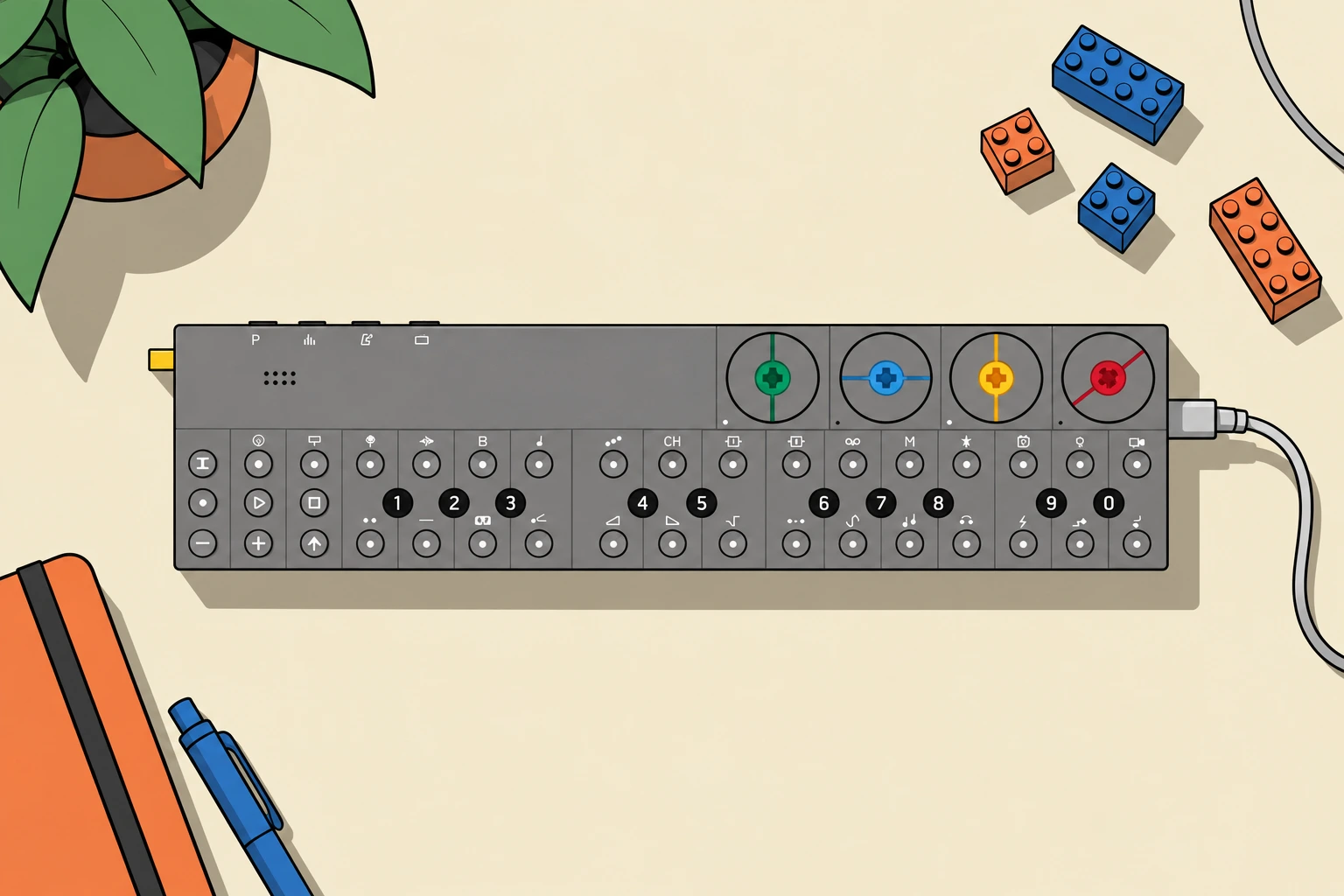
On the OP-1, even the LEGO connection makes sense.
The original OP-1 accessory kit included brick shafts compatible with LEGO. They fitted onto the knobs, allowing a wheel or a more elaborate construction to become part of the control. The kit also included a crank and a bender; the original kit is now listed as unavailable.4
I love that thought. A knob becomes an invitation to build. It connects the seriousness of an instrument with the curiosity of playing with bricks. The unexpected detail has a purpose: it gives your hands another way into the sound.
The calculator I would happily make room for.
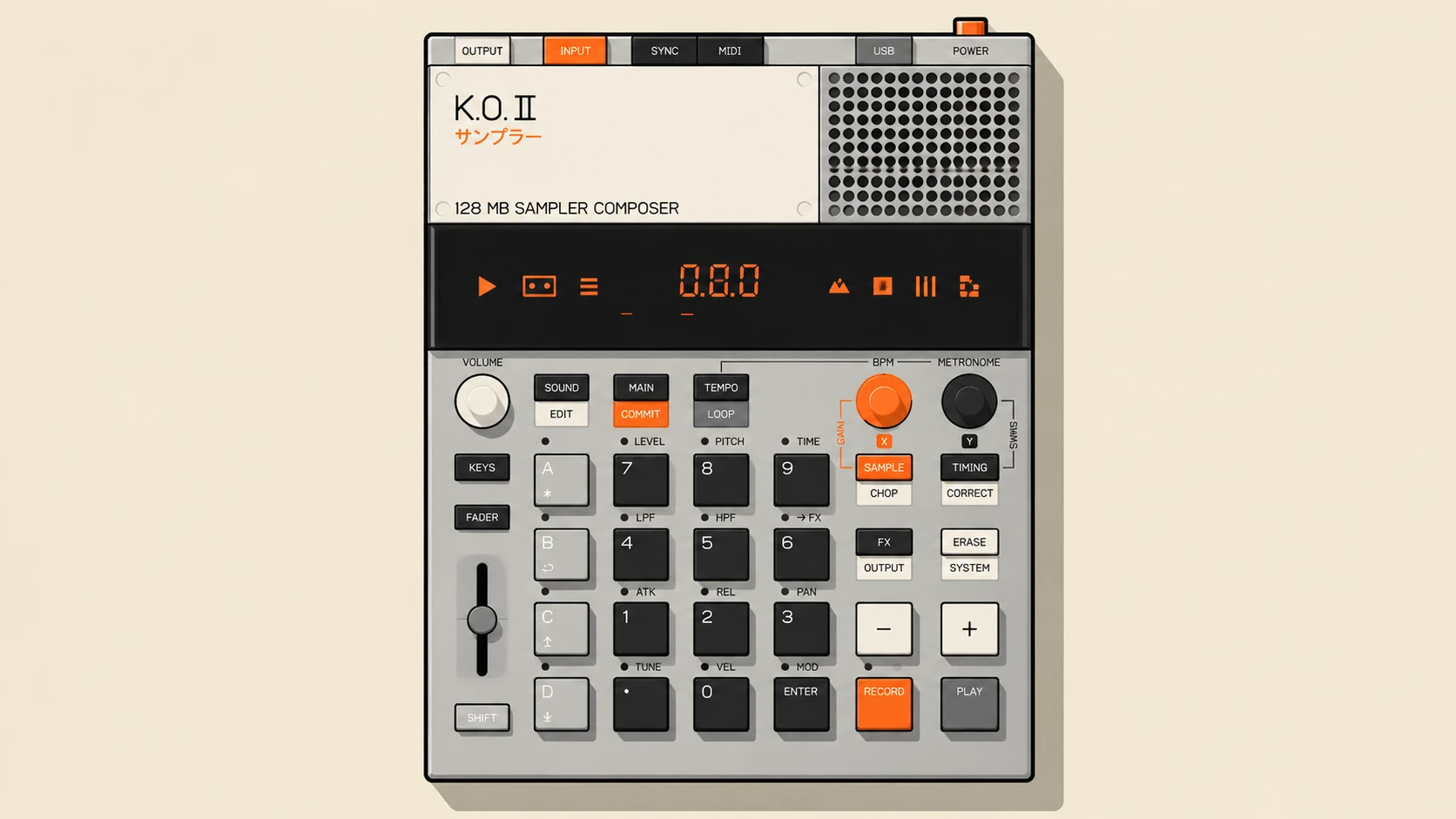
The EP–133 K.O. II is still high on my wish list. To my eye, it looks like a calculator that grew up with much more interesting ambitions. The grey body, dark display, number-pad rhythm and orange accents make a wonderful composition.
It is a sampler and composer: record a sound, put it into a pattern and shape it into a beat. Pressure-sensitive pads, a physical fader and punch-in effects bring performance into that process.1
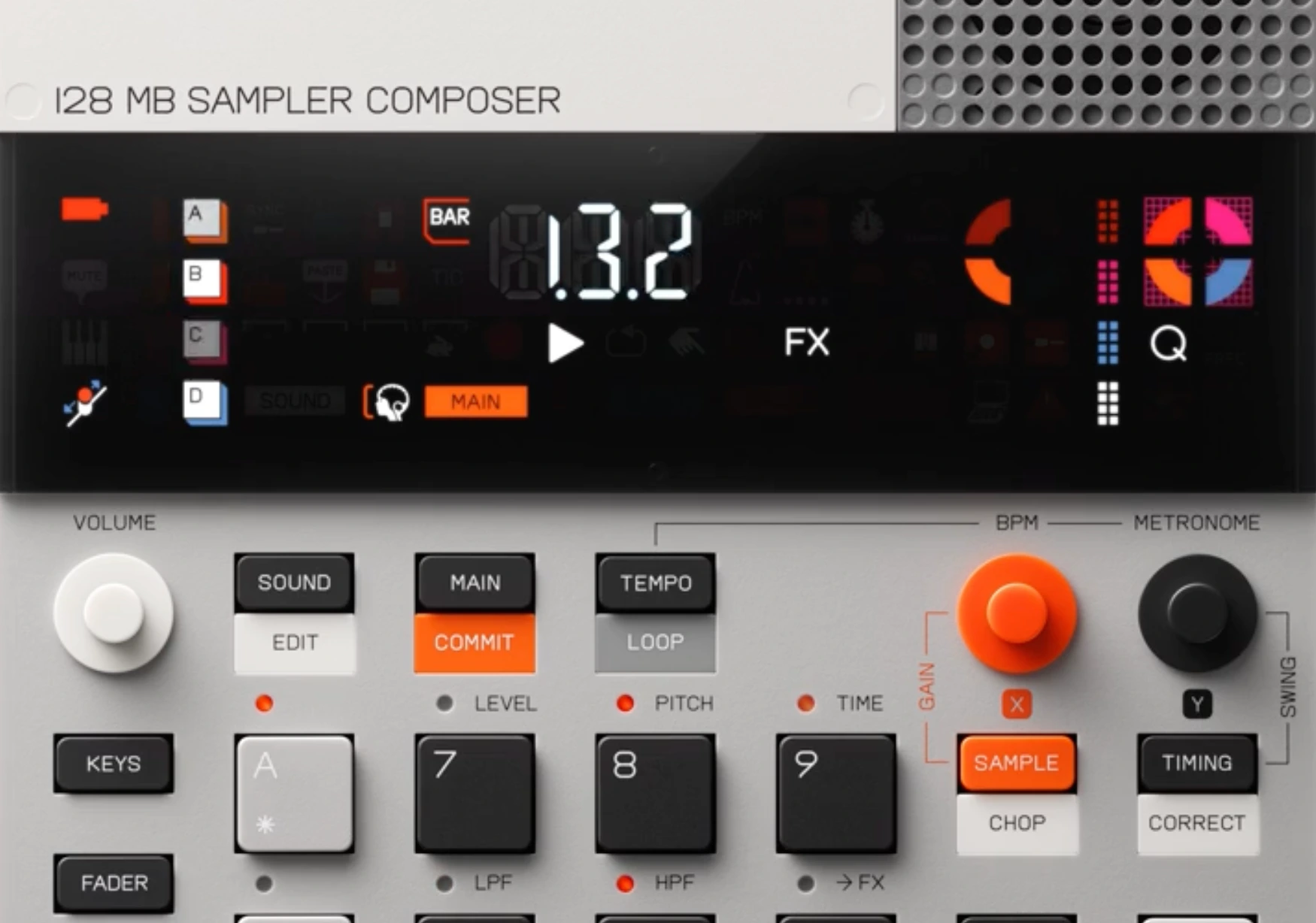
I find its front panel fascinating as graphic design. There are dense areas and quieter ones, repeated shapes and small interruptions. The orange gives my eye somewhere to land. Its character comes from how the parts are arranged, as much as from any single part.
My admiration here comes from looking at the design and its possibilities. I have not added the K.O. II to my own setup yet. But it is the kind of object that makes me imagine what I could make with it.
A medieval beat machine. Of course.
The EP–1320 Medieval takes this sense of play into an entire world: hurdy-gurdies, lutes, chants and percussion, with effects given names such as dungeon echo and torture chamber reverb.5 The language, the sounds and the presentation belong to the same idea.
Then there is the EP–40 riddim, built around reggae, dub, dancehall and sound-system culture. Its sound library, bass and lead synthesis, dub siren and live-loop performance mode carry that direction into the instrument itself.6
What I admire is the commitment. Each has a recognisable premise, and that premise reaches into what you hear and what you do. It makes me want to ask more of a concept: how far can it shape the experience?
The thinking extends beyond synthesizers. The OB-4 speaker and radio can rewind and loop what you have been listening to, using a rolling recording.7 Even listening becomes something you can interact with. That is the sort of unexpected, practical invention I find exciting.
What I take back to my own work.
I want to keep that sense of curiosity close, especially while working with AI. New technology gives us more ways to make things. The interesting design question is what we choose to make, and how it feels to use.
Teenage Engineering keeps reminding me to connect the concept, the form and the interaction. To make room for humour. To think about the hand as well as the eye. And to give an unexpected idea enough practical substance that somebody can do something with it.
That is why they inspire me so much. I enjoy looking at their products, and I enjoy the urge to pick one up and start making.