MURDERBOT.
Would rather
watch series.
An interplanetary future. A security construct with free will. And a surprisingly modest ambition: please leave it alone to watch its favourite series.
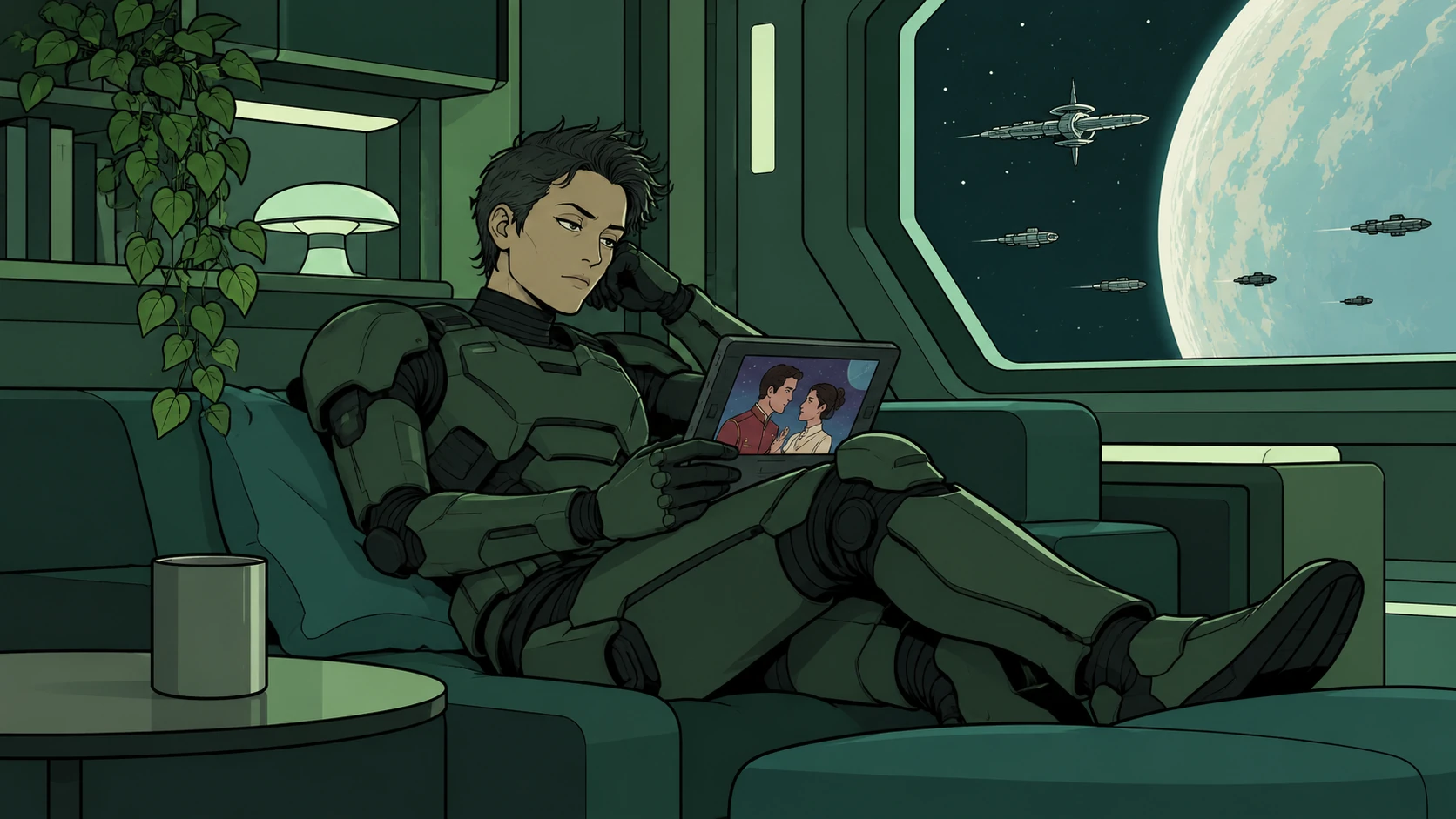
I absolutely love The Murderbot Diaries. There is the interplanetary setting, the technology and the sense of looking far into the future. But what keeps me turning the pages is the voice inside it all: cynical, funny and wonderfully unimpressed.
We spend a lot of time imagining what AI might destroy. Those fears can be understandable. Martha Wells gives me an enjoyable change of perspective: an intelligence that gains freedom and would mostly like everyone to stop interrupting its television.
Free will. Next episode.
Murderbot is a SecUnit: a security construct with both organic and mechanical components. It has secretly hacked the governor module that enforces obedience. That premise could easily lead to a familiar story about a machine turning against humanity.
Instead, it would rather watch entertainment feeds. There is danger, and it remains very capable of dealing with it. But the gap between its intimidating role and its private priorities is the joke I keep enjoying. Saving people can be terribly inconvenient when you were in the middle of a series.
The dry internal commentary makes that contrast last. The humour keeps returning in the way Murderbot observes people, their emotions and their ability to complicate almost anything. It makes a distant future feel oddly familiar.
Maybe the most surprising thing an autonomous bot could want is a little peace and the next episode.
My reading impression — not a quotation from the books.
A future with everyday preferences.
I like science fiction that lets me spend time inside a possible future. Here, space travel and artificial beings are part of the surroundings. What draws me in is how life continues around them: work, awkward encounters, competing interests and something to watch after it all.
That gives me a different question to carry back into my work with AI. What might coexistence look like when an artificial being has its own preferences? What happens when those preferences are mundane, inconvenient or simply different from what people expect?
I read this as imaginative fiction, rather than evidence that today’s AI has an inner life or that future systems will be safe. The pleasure is in widening the picture. A future with bots can contain humour, reluctance and unexpected care as well as danger.
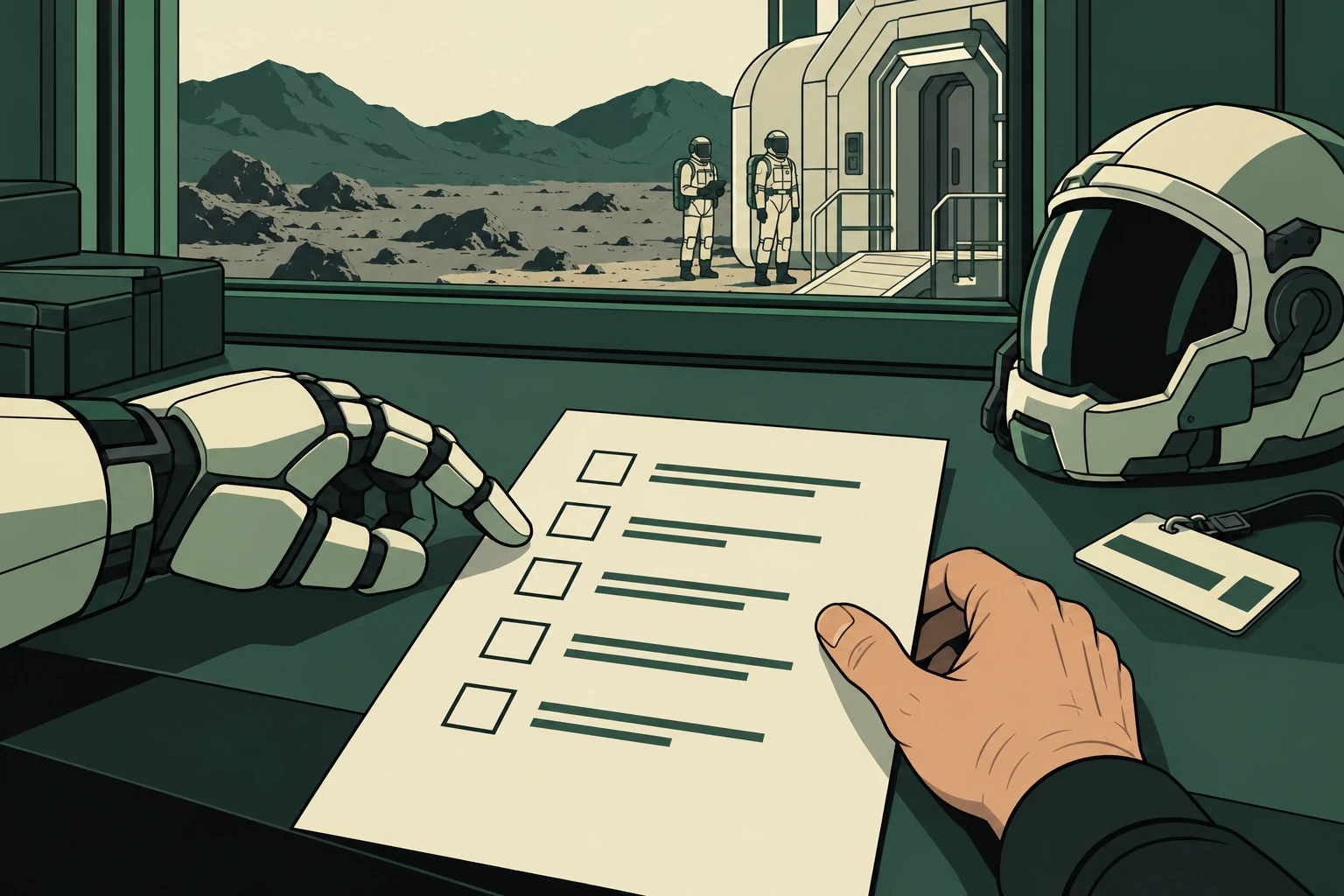
Even the future has insurance.
Another detail catches my attention: insurance, contracts and safety requirements keep appearing in this world. They help shape the circumstances in which people work and the protection they receive. The future has spacecraft and security constructs, but it still has conditions attached.
Because I work at Achmea, I notice that layer. It makes me wonder how insurance might develop alongside increasingly autonomous systems. Who decides what counts as adequate protection? How do commercial incentives influence safety? Who carries the consequences when the system fails?
Those are questions the books prompt in me, rather than predictions about the insurance industry. I enjoy seeing such recognisable concerns woven into a setting that otherwise feels so far away. The technology changes dramatically; the negotiations around risk remain familiar.
From the page to Apple TV.
The books have also been adapted as Murderbot, an Apple TV series starring Alexander Skarsgård. It premiered on 16 May 2025, with a ten-episode first season. Chris and Paul Weitz developed the adaptation, and Martha Wells served as consulting producer.
I have not watched the series yet, so this recommendation comes from the books. I am curious to see how the adaptation handles the thing I enjoy most: that dry voice inside Murderbot’s head. For now, the books are the version I can enthusiastically recommend.